A Habit Tracker for Kids Printable That Actually Stuck in Our House
My niece is five, and for a while, mornings at her house followed the same script: tears over brushing teeth, a missing shoe, somebody running late for preschool. I had already built a habit tracker for adults, so I assumed a kids version would be the easy part. It wasn't, not until I stopped treating a five-year-old like a smaller grown-up.
What finally worked wasn't another lecture about responsibility. It was color, a path to walk along, and something she could actually hold in her hands at the end.
That's how a habit tracker for kids printable called 31 Little Habits ended up taped to her fridge, one little stone colored in at a time, through the full challenge.
Why Most Sticker Charts for Kids Stop Working
Before this, we tried the usual sticker chart for toddlers, the kind with a grid and a sheet of stickers. It worked for about four days. Then the stickers ran out, or got moved to a different wall, or just stopped meaning anything.
A reward chart for kids only works as long as the reward still feels exciting, and for most five-year-olds, that's not very long.
How to Teach Kids Good Habits at Home
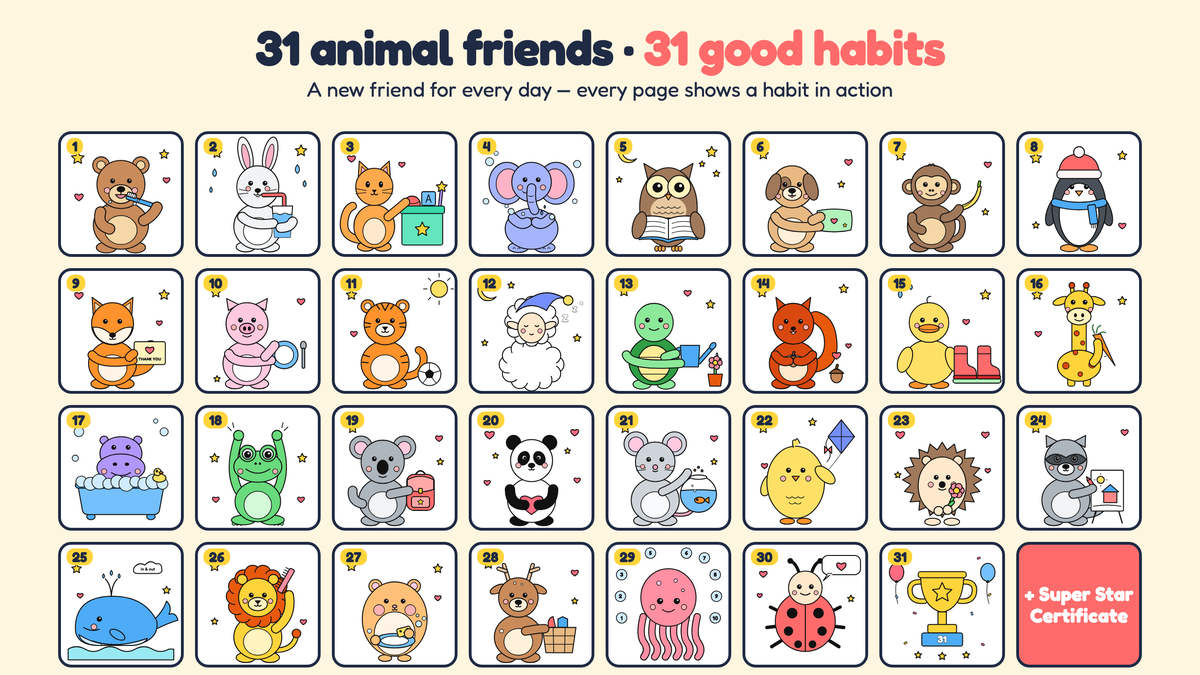
What actually changed things was smaller than I expected. Instead of one big category called "be responsible," we broke it into four parts a kid can actually picture:
- Healthy body - brushing teeth, washing hands, drinking water, bath time, a steady bedtime
- Order and independence - putting away toys, making the bed, getting dressed, packing a backpack
- Kindness - saying thank you, apologizing, sharing, a hug
- Curiosity and calm - reading, drawing, trying something new, a few slow breaths
How to Motivate a Toddler to Brush Teeth Without a Fight
Teeth brushing was our worst fight, every single night. What helped wasn't a longer explanation. It was her coloring in one small stone the next morning and watching the path get a little longer.
A habit tracker wheel for kids spins back to zero every week, which never made sense to her. A path that just keeps growing made a lot more sense to a five-year-old than a wheel that resets.
How to Build a Morning Routine for a Preschooler
Mornings got easier once the routine had an order she could predict, not just a list of demands.
- Wake up and make the bed before anything else
- Get dressed before breakfast, not after
- Brush teeth right after eating, same order every time
- Pack the backpack the night before, not in the morning rush
- Color in the day's stone once everything was done
Designing Kids Habit Tracker Coloring Pages a Five-Year-Old Actually Wants to Use
The habit tracker coloring sheet for kids had to pass one test before anything else: would she ask for it, or would I have to ask her?
We ended up with a daily habit chart for kids free printable covering the first three days, simple enough to test before committing to anything. A habit chart for kids ages 3-7 has to work for a three-year-old's attention span and a seven-year-old's reading level at the same time, which is a narrower target than it sounds.
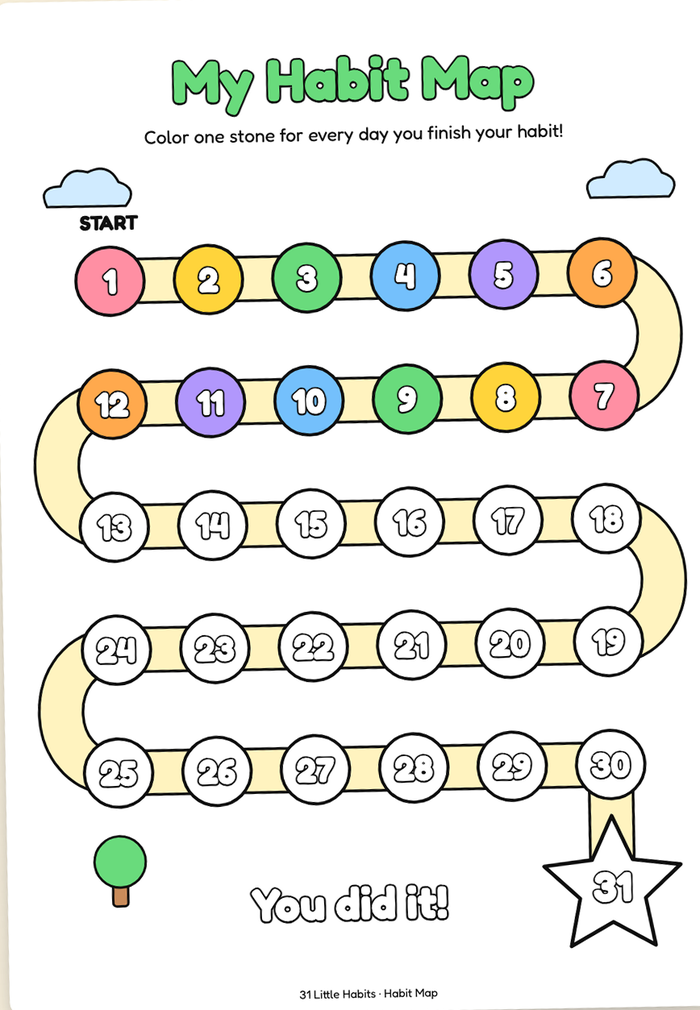
A habit tracker for preschoolers that actually gets used daily usually has less going on, not more. That's the whole idea behind the full 31-day version: one small page a day, and a Habit Map, a path of 31 stones that fills in as the month goes on.
Habit Tracker Formats We Looked At (and Why We Landed on 31 Days)
Before settling on a format, I went through most of what's already out there. A lot of it is built for adults, not five-year-olds.
- A 100-day habit tracker, a 100-day challenge habit tracker, or a 90-day habit tracker asks for more patience than most preschoolers have
- A 75-day habit tracker, a 30-day habit tracker, and a 30-day goal tracker are closer, but still built around adult goal setting, not a kid's attention span
- A 21-day habit tracker or 21-day goal tracker leans on the old, shaky idea that three weeks locks a habit in for good
- A bullet journal habit tracker or bullet journal template assumes someone can draw their own grid every week, which rules out most four-year-olds
- A mandala habit tracker template or a circle habit tracker looks beautiful and asks for fine motor control a five-year-old doesn't have yet
- A mosaic style goal tracker or an undated habit tracker is built to be flexible for adults, not predictable for kids
We also weighed a monthly habit tracker, a weekly habit tracker, a yearly habit tracker, a plain daily habit tracker, and various mini habit trackers, down to a single mini habit tracker for one habit at a time, plus whether to make it an editable habit tracker, a daily routine printable tracker, or a fixed monthly habit tracker pdf. In the end, a fixed 31-day habit calendar printable matched a month a kid could actually see the end of, so we kept the layout simple instead of chasing horizontal and vertical layouts you'd find in a bigger tracker bundle.
How to Use a Habit Tracker, Whatever Tool You Already Have
I already run a habit tracker spreadsheet for my own habits, so my first instinct was to just hand my niece a simpler version of the same thing. That lasted about two days.
What We Tried Before the Coloring Sheet
- A notebook with a hand-drawn grid, where the checklist section had to be redrawn every single week
- A page torn out of my planner, repurposed as a habit calendar with no room for color or decoration
- One of the habit tracker apps on my old phone, which needed a few taps to even open the checklist section
- A plain monthly habit tracker pdf, printed and taped up, functional but forgettable
Practical Steps That Carried Over No Matter the Tool
Whatever the tool, a few practical steps for tracking habits stayed the same:
- Start with goal setting that's small enough a five-year-old understands it without an explanation
- Use a mini habit tracker for one habit before trying an editable habit tracker meant to cover several at once
- Mark the habit the moment it happens, not from memory at the end of the day
- Keep a short daily routine printable tracker nearby so the habit has an obvious place and time
A circle habit tracker or a 21-day goal tracker works well enough for an adult who already understands why they're tracking something. A kid needs the tool itself to do more of the convincing, which is the real reason the notebook, the planner page, and even a 100-day challenge habit tracker style grid never lasted past the first week for her. The self-care habit tracker approach, something closer to a small daily ritual than a productivity system, ended up mattering more than which spreadsheet or app sat behind it.
What Actually Motivates a Kid to Keep Going
A lot of the advice out there leans on the 21/90 rule, the idea that a habit sticks after 21 days and becomes close to automatic by 90. I don't think a five-year-old cares about either number, or about motivation as a concept at all. What she cared about was seeing progress.
Small Steps Over Big Promises
Bite-sized chunks, a mini goal instead of one big one, and clear instructions she could follow without me repeating myself twice did more than any inspirational quote or set of habit quotes taped to the fridge.
- Positive reinforcement and small incentives that happen right away, not at the end of the month
- A visible habit streak she could see growing, not just hear about
- Success criteria simple enough that she knew exactly when a day counted as done
The Benefits We Actually Saw
Benefits of habit tracking for kids showed up in places I didn't expect. It built real accountability, not because I told her to be accountable, but because the page made it visible. Daily routines got easier, and healthy habits stopped needing daily reminders. She started showing a kind of independence and self-regulation I hadn't seen before, along with some pattern identification of her own, noticing on her own which days were harder than others.
It also gave her a sense of accomplishment and a form of visual progress tracking she could check without asking me. None of it was really about time management or monthly goals. It was closer to daily gratitude, noticing the small stuff that usually goes unnoticed.
Why the Coloring Sheet Mattered More Than I Expected
The coloring sheet itself turned out to matter more than the tracking logic behind it. Completed habit spaces filled in with color, little animals scattered through the artwork, and simple visual elements laid out in a specific layout that didn't look like a checklist section from a planner or a to do list - all of it made the page feel like part of a wellness journey instead of one more chore.
We didn't go as far as a climbing book stack theme, or a full tracker bundle of mini tracker designs, core values cards, and monthly goals sheets. One coloring sheet, done honestly every day, turned out to be enough, closer to a self-care habit tracker sized for a five-year-old than a habit tracker spreadsheet or a 30-day reading routine chart would have been.
How to Make a Chore Chart That Actually Works
The order and independence days are basically a chore chart for kids in disguise: put away toys, make the bed, get dressed, pack a backpack. Calling it a chore chart out loud never worked at our house. Calling it a stone on the path did.
Chore Chart vs Reward Chart for Kids
A chore chart vs reward chart for kids debate usually comes down to what happens at the end. A reward chart promises a prize somewhere in the middle. This is closer to a chore chart with a reward chart's payoff built into the finish, not scattered along the way.
Best Age to Start a Chore Chart for Kids
The honest answer to the best age to start a chore chart for kids is whenever a child can point to a picture and understand what it means, which is usually somewhere around three. A 31 day challenge printable for kids works at the younger end of that range too, because each day only asks for one small thing, not a list.
A Simple Reward System for Kids That Actually Works
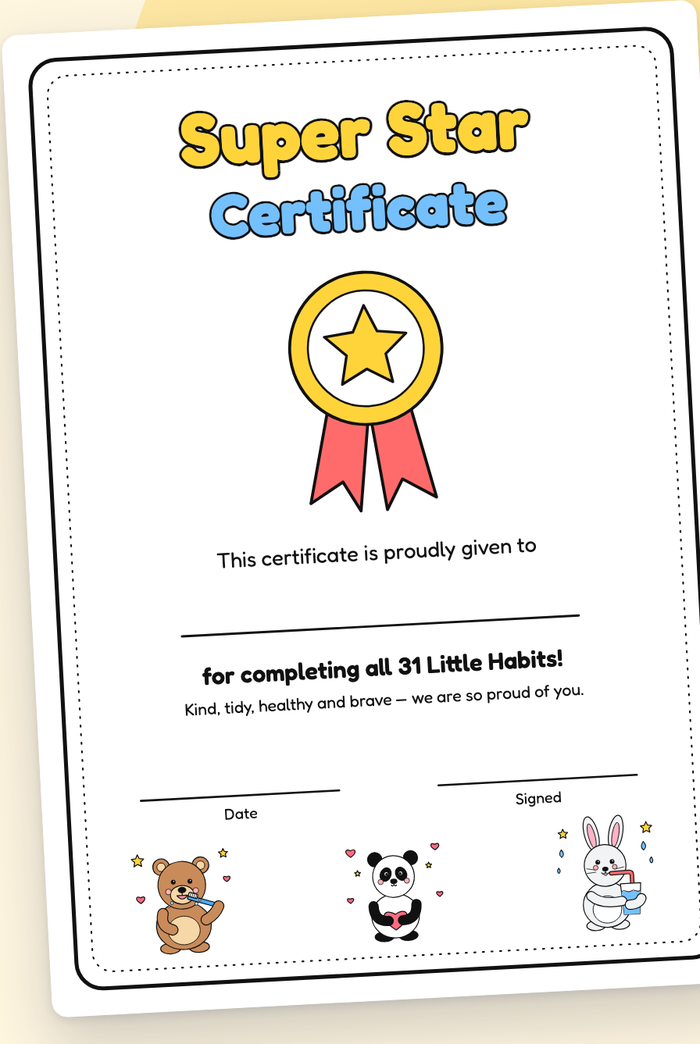
The payoff at the end mattered more than I expected. A Super Star Certificate, printed and signed, turned 31 small days into one thing she could point to and say she finished.
If a sticker chart has already stopped working at your house, this is the version we built after watching ours fail too: Free Basic covers the first three days, and the Full Challenge covers all 31, for $4.99.
FAQ
How many habits should a kid track at once?
One, maybe two, especially under age six. A five-year-old doing one small thing a day finishes the week; the same kid doing five things a day usually finishes nothing.
Does tracking habits actually help kids build discipline?
It helps them see a pattern they couldn't see otherwise, which is most of what discipline actually is at that age. The tracking matters less than the fact that effort finally became visible to them.
Why do sticker charts stop working after a while?
Usually because the reward stops feeling special long before the behavior becomes automatic. A sticker chart that resets every week never lets a kid see the whole picture, only the current one.